Real Lives, Real Journeys: Case Studies in Wheelchair-Accessible Motoring Across the UK

Accessible motoring is rarely a straightforward process. It involves navigating funding schemes, identifying the right vehicle, sourcing reliable adaptations, and — often — managing a significant emotional and logistical burden alongside a disability or caring responsibility. The following case studies draw on real-world scenarios representative of the experiences shared by wheelchair users and their families across the United Kingdom. Names have been changed to protect privacy, but the circumstances and solutions described are grounded in the genuine challenges people face every day.
Case Study 1: Margaret, 71 — Transitioning to a Passenger Wheelchair Vehicle After a Stroke
Margaret, a retired teacher from Shropshire, experienced a stroke in her late sixties that left her with significant mobility impairment. Prior to her stroke, she had been an independent driver. Following her recovery, she found herself reliant on her husband, David, for all transportation.
The couple initially assumed that a standard family car with a boot-mounted wheelchair carrier would suffice. After two years of struggling with transfers, back pain for David, and growing anxiety for Margaret around journeys, they sought advice from a local Motability-approved dealership.
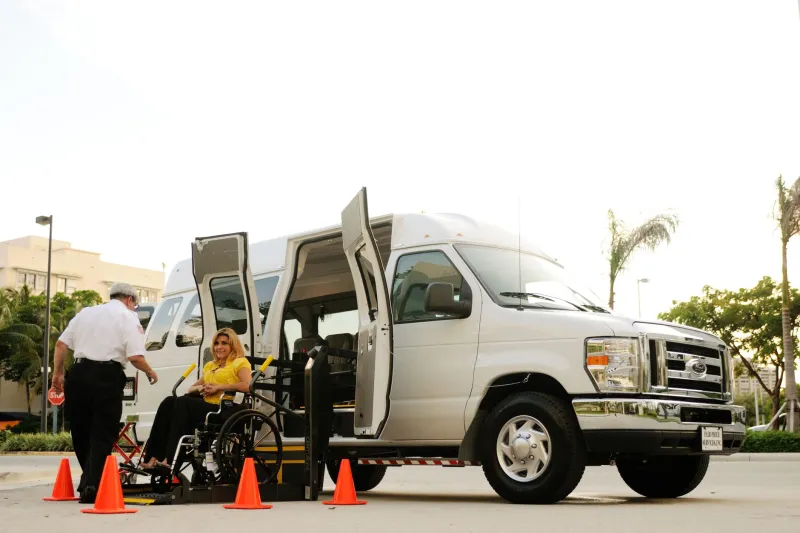
Through a referral to an occupational therapist, Margaret was assessed and found eligible for the higher rate mobility component of Disability Living Allowance (DLA). This unlocked access to the Motability Scheme, and the couple ultimately leased a Volkswagen Caddy Life with a rear-entry ramp conversion. The vehicle allows Margaret to remain in her powered wheelchair throughout the journey, eliminating transfers entirely.
Key takeaways: An occupational therapist assessment can be transformative in identifying the most appropriate vehicle type. Passenger wheelchair vehicles are often overlooked in favour of adapted standard cars, even when the former would significantly improve quality of life for both the passenger and the carer.
Case Study 2: James, 34 — A Powered Wheelchair User Returning to Independent Driving
James, who lives in Leeds and has a spinal cord injury sustained in his mid-twenties, spent several years as a passenger before deciding to pursue independent driving. His injury affects his hands, making standard controls impossible to use safely.
Following a driving assessment at a regional mobility centre — part of the Driving Mobility network — James was recommended a combination of hand controls, a steering ball, and left-foot accelerator. He was also advised to consider a vehicle with automatic transmission and a swivel seat to aid entry and exit.
James applied for a grant through the Access to Work scheme to assist with adaptations required for commuting purposes, and used the Motability Scheme for the vehicle itself, selecting a Ford Focus Estate. The conversion was carried out by a specialist adapter approved by the Vehicle Certification Agency (VCA).
He now drives independently to his place of work and reports that regaining the ability to drive has had a profound impact on his confidence and sense of autonomy.
Key takeaways: Driving Mobility assessment centres offer impartial, expert guidance on adaptations. Access to Work can provide funding for adaptations when the vehicle is used for employment purposes, complementing or supplementing Motability provision.
Case Study 3: Priya, 45 — A Carer Sourcing a Wheelchair-Accessible Vehicle on a Limited Budget
Priya, based in Birmingham, is the primary carer for her teenage son Arjun, who has a progressive neuromuscular condition and uses a powered wheelchair full-time. When Arjun's condition advanced to the point where he could no longer be safely transferred in and out of a standard car, Priya began researching wheelchair-accessible vehicles.
The family did not qualify for the Motability Scheme as Arjun's PIP award was at the standard rather than enhanced rate. Priya turned to the Family Fund and a local disability charity for financial assistance, ultimately receiving contributions that enabled her to purchase a second-hand Peugeot Partner Tepee with a pre-installed ramp system.
She also contacted her local council's social care team, who arranged a Disabled Facilities Grant assessment. Although this grant primarily supports home adaptations, the assessment led to a referral for further transport-related support through the council's independent living programme.
Key takeaways: When the Motability Scheme is not accessible, multiple alternative funding streams exist. Families should explore local authority support, charitable grants, and the Family Fund in parallel. Purchasing a used accessible vehicle with existing conversions can significantly reduce costs.
Case Study 4: Robert, 58 — Managing a Degenerative Condition and Planning Ahead
Robert, a former engineer from Edinburgh, was diagnosed with multiple sclerosis in his early fifties. In the years following his diagnosis, his mobility deteriorated gradually, and he began using a manual wheelchair part-time. Aware that his condition was likely to progress, Robert made the decision to plan his motoring arrangements proactively rather than reactively.
He attended a Driving Mobility assessment while still able to drive, receiving guidance on the adaptations most likely to extend his driving career as his condition progressed. He also consulted his benefits adviser to ensure he was claiming all eligible allowances, and subsequently transitioned to the enhanced rate of PIP mobility, unlocking Motability Scheme access.
Robert selected a vehicle with a powered tailgate, swivel seat, and hand controls, and has since renewed his Motability lease once, upgrading to a vehicle with additional accessibility features as his requirements have changed.
Key takeaways: Proactive planning is significantly less stressful than reactive decision-making during a period of declining mobility. Driving Mobility assessments are available to drivers at any stage of a condition's progression, not only those who have already stopped driving.
What These Journeys Have in Common
Despite the diversity of circumstances represented above, several consistent themes emerge from these case studies:
- Professional assessment is invaluable. Whether from an occupational therapist, a Driving Mobility centre, or a benefits adviser, expert guidance consistently leads to better outcomes.
- Multiple funding sources often need to be combined. Very few individuals access a single, straightforward funding route. Most successful outcomes involve piecing together support from several schemes.
- The emotional dimension matters. Regaining or maintaining independent motoring — or enabling a loved one to travel safely — has profound effects on wellbeing, confidence, and social participation.
- Early action pays dividends. Those who begin planning before reaching a crisis point consistently report smoother transitions and more suitable outcomes.
If your circumstances resemble any of those described above, the resources section of WheelAir provides detailed guidance on funding options, vehicle types, and how to access professional assessments across the United Kingdom.