Choosing Between Manual and Automatic Transmission: A Practical Guide for Wheelchair Users in the UK
For most drivers, the debate between manual and automatic transmission comes down to personal preference, fuel economy, or the simple fact of what they learned to drive in. For wheelchair users and individuals with limited upper or lower limb mobility, however, the decision carries considerably more weight. The wrong choice can make driving unnecessarily difficult or, in some cases, unsafe. The right one can open up a level of independence that many people assume is beyond their reach.
This article explores the practical differences between the two transmission types from an accessibility standpoint, covering real-world driving conditions, the role of adaptive hand controls, and guidance on which configuration is likely to suit different disability profiles across the UK.
Why Transmission Type Matters More Than You Might Think
Driving a vehicle requires the coordination of multiple actions simultaneously — steering, braking, accelerating, and, in a manual car, operating the clutch and gear lever. For drivers without any limb impairment, these tasks become second nature. For those managing reduced grip strength, limited arm reach, partial paralysis, or the physical demands of transferring from a wheelchair, each additional control input represents a meaningful challenge.
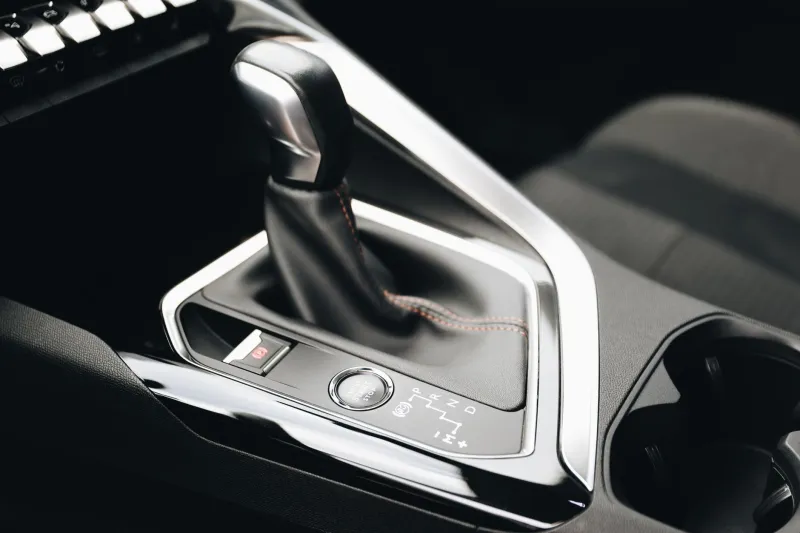
Manual gearboxes require the driver to operate a clutch pedal with the left foot while simultaneously selecting a gear with the left hand — a combination that is effectively impossible for many wheelchair users, particularly those with lower limb paralysis or those who drive using hand controls. Automatic transmissions eliminate the clutch entirely and manage gear changes without driver input, reducing the number of tasks required to keep a vehicle moving safely.
This is not simply a matter of convenience. For many disabled drivers in the UK, an automatic transmission is a functional necessity rather than a luxury upgrade.
The Reality of Driving with Hand Controls
Hand controls are adaptive devices fitted to a vehicle that allow the driver to operate the accelerator and brake using their hands rather than their feet. They are among the most widely used adaptations in the UK's adapted vehicle market and are commonly fitted to vehicles accessed through the Motability Scheme.
The critical point here is that hand controls are almost universally paired with automatic transmissions. When the accelerator and brake are both managed by hand, adding a manual gear change and clutch operation into the same set of upper limb actions creates a level of cognitive and physical demand that is neither practical nor safe for most drivers. An automatic gearbox allows the driver using hand controls to focus entirely on steering, braking, and acceleration — a manageable combination that many people with significant mobility impairments can learn to handle effectively.
Some highly specialised adapted vehicles do exist with manual transmission and hand controls, but these are rare, expensive, and typically require bespoke engineering. For the overwhelming majority of wheelchair users and hand control drivers in the UK, automatic transmission is the realistic and recommended starting point.
Driving Scenarios: Where Each Transmission Performs Differently
Understanding how each gearbox type behaves across common UK driving situations helps clarify which is better suited to different needs.
Urban and stop-start driving: In city traffic, roundabouts, and congested town centres — all of which are abundant across the UK — manual vehicles require frequent gear changes and clutch engagement. For drivers with fatigue conditions such as multiple sclerosis or those with limited arm endurance, this repeated effort can become exhausting over even short journeys. Automatic vehicles handle these transitions seamlessly, reducing physical output and allowing the driver to concentrate on road awareness.
Motorway and dual carriageway driving: At sustained higher speeds, manual gearboxes require fewer changes, which narrows the gap between the two systems. However, modern automatic transmissions — particularly those with eight or more ratios — are highly efficient at motorway speeds and no longer carry the fuel economy penalty they once did.
Rural roads and hills: Hill starts in a manual vehicle require precise coordination of the clutch, accelerator, and handbrake. For drivers with limited lower limb function or those relying on hand controls, this manoeuvre presents a genuine risk. Automatic vehicles with hill-start assist — now standard on most modern models — handle this without any additional input from the driver.
Fuel Economy: Addressing a Common Concern
Historically, manual gearboxes offered a measurable fuel efficiency advantage over automatics. This was a significant consideration for many drivers and was often cited as a reason to persevere with manual transmission where possible. The landscape has changed considerably.
Contemporary automatic transmissions, including dual-clutch systems and continuously variable transmissions (CVTs), have largely closed this gap. Many modern automatic vehicles now match or exceed the fuel economy of their manual equivalents. For drivers accessing vehicles through the Motability Scheme, where lease terms and advance payments are fixed, the day-to-day running cost difference between the two is unlikely to be substantial.
Drivers who are weighing up a private purchase should compare official WLTP fuel figures for specific models, as the difference varies considerably by manufacturer and vehicle class.
Matching Transmission Type to Disability Profile
While automatic transmission is the appropriate choice for the majority of wheelchair users and hand control drivers, it is worth considering individual circumstances more carefully.
Lower limb paralysis or amputation: Automatic transmission is effectively essential. Without functional use of the feet, clutch and foot-operated accelerator inputs are unavailable, making hand controls and an automatic gearbox the standard configuration.
Upper limb weakness or reduced grip: Some drivers with conditions affecting hand strength — such as muscular dystrophy, cerebral palsy, or arthritis — may find that even the lighter actions required in an automatic vehicle benefit from further adaptation, such as a spinner knob on the steering wheel or a reduced-effort gear selector. Occupational therapists and Driving Mobility assessment centres across the UK can advise on appropriate combinations.
Partial limb function or single-arm driving: Drivers with the use of one arm will almost certainly require an automatic vehicle, as the demands of steering, gear changing, and clutch operation cannot safely be combined with a single upper limb.
Progressive conditions: For drivers whose condition is expected to change over time — such as those with Parkinson's disease or MS — choosing an automatic vehicle from the outset offers greater longevity of use and reduces the need for future vehicle changes.
Getting the Right Assessment
Before committing to a vehicle, any driver with a disability or medical condition affecting their mobility should undertake a formal driving assessment. Driving Mobility, which operates assessment centres across England, Scotland, and Wales, provides specialist evaluations that take into account both the individual's physical profile and the most appropriate vehicle and adaptation combinations.
These assessments are not simply about confirming whether someone can drive — they provide tailored recommendations on transmission type, hand control configuration, seating adaptations, and any other modifications that would support safe, independent driving.
For those accessing a vehicle through the Motability Scheme, the assessment process can also inform which vehicles on the scheme's list are practically suitable, helping to avoid a costly mismatch between driver need and vehicle specification.
A Clear Direction for Most Drivers
The evidence points consistently in one direction: for wheelchair users and those with significant mobility impairments, automatic transmission offers a safer, more manageable, and more sustainable driving experience. The operational simplicity it provides is not a compromise — it is an enabler, and for many drivers it is the foundation upon which genuine independence is built.
That said, every driver's situation is unique. Taking professional advice, completing a formal assessment, and test-driving adapted vehicles before making a final decision will always produce a better outcome than selecting based on assumption alone.